

For high-performance technical textiles, choosing the right weave or construction is the foundation for creating functional materials, especially when these substrates are combined with TPU coatings to enhance performance and lifespan.
PANAMA WEAVE
The Panama weave is a variation of the plain weave where multiple warp and weft threads are interlaced together.
Appearance: The Panama weave is a derivative of the Oxford weave, with groups of yarns weaving over and under one another. Most commonly, each group consists of two yarns, and the pattern is classified as a 2 x 2 Panama weave design. This has a repeat of four ends and four picks. Two ends weave over two picks as one. Fabric woven in this design has more texture and better drape, but is not as stable as the simple Oxford weave fabric.
Properties: This construction creates a distinct, cube-like surface structure that is exceptionally tear-resistant and stable.
Application: It is the ideal base for heavy-duty coatings like truck tarps or architectural membranes because the structure provides an excellent mechanical anchor for the coating.
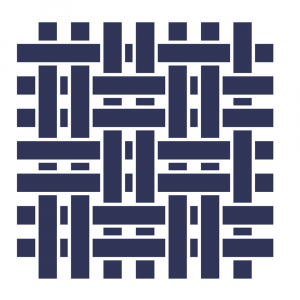
panama construction

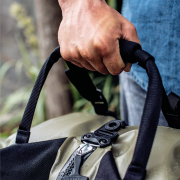


typical applications
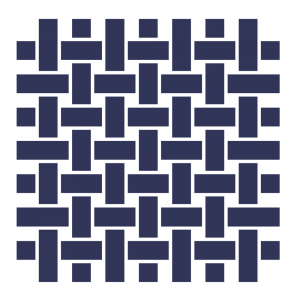
oxford construction
OXFORD WEAVE
Oxford is a durable fabric construction where a heavier weft thread is typically woven with several finer warp threads.
Properties: Oxford fabrics are hard-wearing yet flexible, offering a perfect balance between weight and durabilit.
Application:Widely used in outdoor gear and bags, as it provides high water resistance and a technical aesthetic when combined with TPU coating or lamination.
MESH
Mesh is an open, grid-like fabric stabilized through specialized weaving techniques
Properties: Offers high air permeability and transparency while maintaining dimensional stability.
Application:Used in the medical sector for ventilation or as a reinforcement layer in high-strength composite materials.
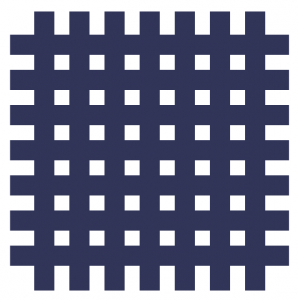
mesh construction
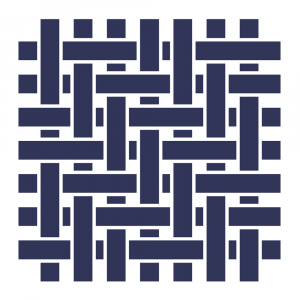
herringbone construction
HERRINGBONE
A variation of the twill weave, Herringbone is characterized by a zigzag pattern created by reversing the direction of the slant at regular intervals.
Apperance: Threads create Zigzag, 3D pattern.
Properties: Provides superior dimensional stability, preventing the fabric from distorting or stretching excessively under tension.
Application:Preferred for applications requiring both technical function and a premium aesthetic, such as specialized workwear or high-end outdoor lifestyle products.
TWILL
Identified by its characteristic diagonal parallel ribs.
Apperance: Threads create diagonal lines across the fabric.
Properties: Twill fabrics are softer and more drapeable than plain weaves. They exhibit high abrasion resistance and flexibility.
Application:Due to its ability to follow complex shapes, it is ideal for technical applications like CIPP (Cured-In-Place Pipe) liners for trenchless pipe rehabilitation or complex medical cushioning.
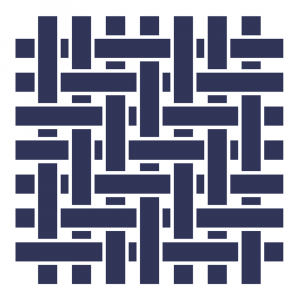
twill construction
APPLICATIONS
PERFORMANCE
Adhesion
- N/mm
Tightness
- IPX9
Temperature
- -20 / +70 C
tear tensile strength
- N/mm
Adhesion
- N/mm
GEOMETRY, WEIGHT, OPTIC
Width
- 1,60 m
- max. 500 gr./m²
Length
- min. 50 m
- max. 500 gr./m²
Weight
- min. 250 gr./m²
- max. 500 gr./m²
Optic
- shiny
- mat
Width
- 1,60 m
- max. 500 gr./m²
CONFIGURATION OPTIONS
Textile
- Polyester
- Oxford
- Mesh
- Harrinbone
- Twill
- Nonwoven
- Film
Quality
- Panama
- Oxford
- Mesh
- Harrinbone
- Twill
- Nonwoven
- Film
Coating
- TPU (single sided)
- TPU (double sided)
- Mesh
- Harrinbone
- Twill
- Nonwoven
- Film
Hardness
- 80 Shore A
- Oxford
- Mesh
- Harrinbone
- Twill
- Nonwoven
- Film
Options
- UV Protection
- Hydrolysis Protection
- FDA compliant
- Antibacterial
- Embossing
- Nonwoven
- Film
COLORS
STANDARD PANTONE COLORS


SEASONAL PANTONE COLORS


